

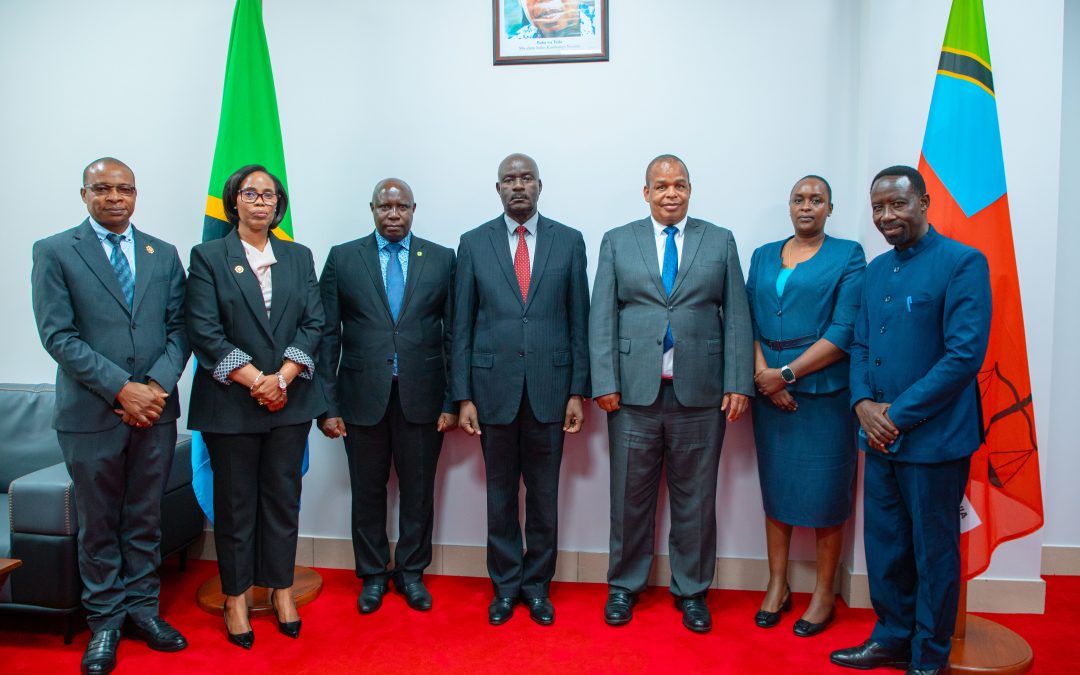
East African Court of Justice, Arusha, Tanzania, 3rd February 2026: The Hon. Judge President of the East African Court of Justice (EACJ), Justice Nestor Kayobera, accompanied by the Hon. Principal Judge, Justice Yohane Masara, and Acting Registrar Her Worship Christine Mutimura, attended the Tanzania Law Day celebrations at Judiciary Square in Dodoma. The Vice President of the United Republic of Tanzania, Dr. Emmanuel Nchimbi, officiated as Guest of Honour.
The event highlighted judicial independence, efficiency, and reconciliation for national unity. Discussions focused on integrating artificial intelligence into court processes, delivering judgments in Kiswahili, and expediting justice to strengthen public confidence in the judiciary.
During the celebrations, Judge President Kayobera paid a courtesy visit to the Chief Justice of the United Republic of Tanzania, Hon. Justice George Mcheche Masaju, and congratulated him on his recent appointment. He recalled their long-standing professional collaboration in EAC Sectoral Council meetings, including negotiations on EAC protocols.
Judge President Kayobera expressed gratitude to the Judiciary of Tanzania for its ongoing support to the EACJ, including past provision of office space in Dar es Salaam and most recently the offering of facilities for the Court’s sub-registry in Dodoma. He also commended the strong collaboration between the judiciary and the Government of the United Republic of Tanzania, noting that the Government’s timely financial contributions to the East African Community have enabled the EACJ to operate efficiently, hold sittings as scheduled, and maintain a secure working environment for judges.
Judge President Kayobera highlighted the introduction of rotational court sessions as a major step toward reinforcing judicial independence and regional integration. He said the initiative began in Burundi (2021), continued in Kampala (2022), and in Kigali (2025), with strong support from host judiciaries. These rotations, he said, enhance the EACJ’s independence and visibility; the next sessions are planned for Kenya, followed by Tanzania.
Chief Justice Masaju observed that rotational court sessions further the Treaty’s objectives of widening and deepening East African Community integration by bringing the Court closer to the people and enhancing access to justice across the region. He expressed appreciation for the EACJ delegation’s visit and reiterated the importance of maintaining and strengthening institutional relationships.
The Chief Justice reaffirmed Tanzania’s commitment to continue hosting the EACJ and confirmed the Judiciary of Tanzania’s readiness to support future rotational sessions.
Both leaders underscored the need for continued collaboration anchored in good faith, teamwork, and judicial diplomacy as essential to strengthening the EACJ, safeguarding judicial independence, and advancing regional integration.
About the EACJ
The East African Court of Justice (EACJ or ‘the Court’), is one of the Organs of the East African Community established under Article 9 of the Treaty for the Establishment of the East African Community. The Court was established in November 2001; its key mandate is to ensure the adherence to law in the interpretation and application of and compliance with the EAC Treaty. Arusha is the temporary seat of the Court until the Summit determines its permanent seat. The Court’s sub-registries are located in the capitals of the following Partner States: Burundi, Kenya, Rwanda, Uganda and United Republic of Tanzania.
For more information please contact:
Christine Mutimura
Acting Registrar,
East African Court of Justice.
Arusha, Tanzania
Tel: 255-27-2162149
Email: cmwekesa@eachq.org