
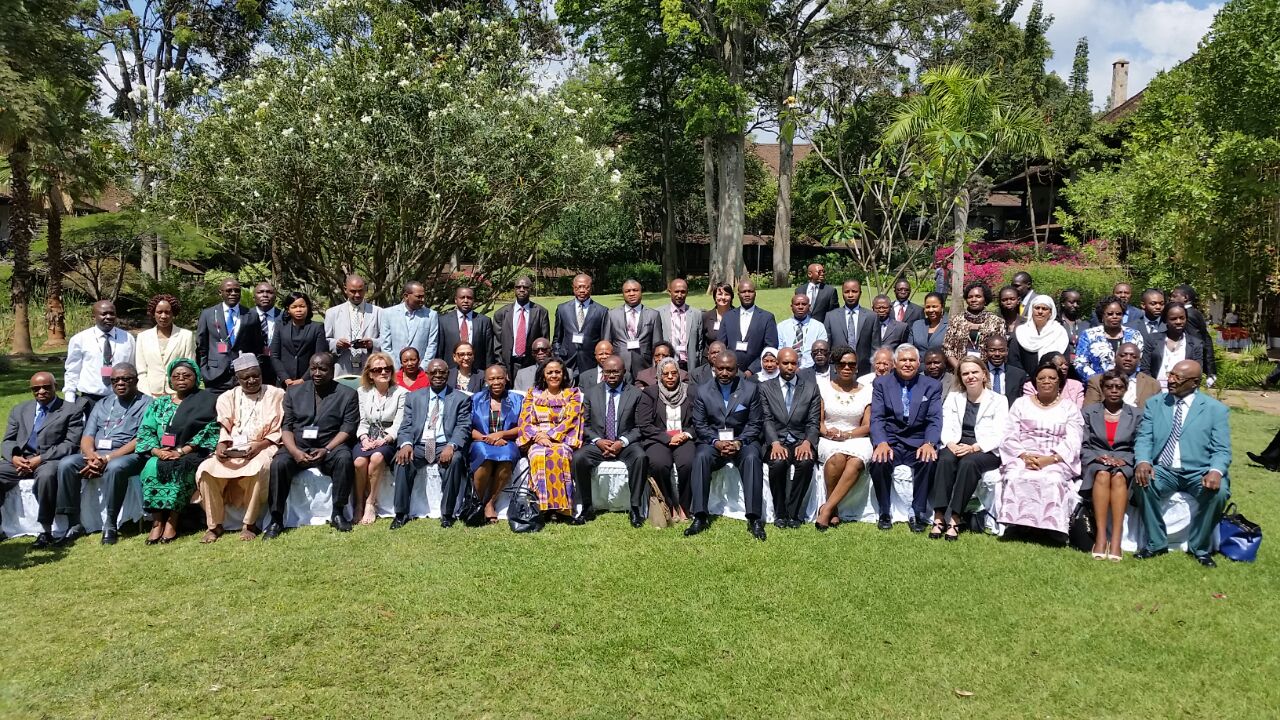

A Group Photo Opportunity of the Ombudsmen attending the Colloquium with the Judge President (Chief Guest) 7th from Left
The East African Court of Justice Nairobi, 19 February 2015: Hon. Justice Dr. Emmanuel Ugirashebuja who was the Chief Guest officially opened the 2nd Regional Colloquium of African Ombudsmen that is taking place in Nairobi, Kenya at the Safari Hotel Park Hotel. The meeting whose theme is; “Securing the Ombudsman as an instrument of governance and accountability in Africa” was organized by the Republic of Kenya and attended by a number of Ombudsmen from various African Countries including the East African Partner States.
The Key note Speaker, His Lordship Justice Ugirashebuja, in his opening remarks stated, “What is the purpose of these annual gatherings? Why do you put aside your customary employment?” The Judge President said that objective of the colloquium reveals that what brings them together is the influence of the aspiration; to facilitate and enhance the development of the institution of the Ombudsman, through sharing of knowledge experience, and ideas to promote good governance in public administration, improved delivery of public service, and respect for justice and equality in the pursuit of improved human development.
The Chief Guest further said that, the concept of the Ombudsman is not a strange phenomenon in African traditions. In former times, the institutions were put in place in different cultures which played a similar role to that of the present Ombudsman. That the idea of the elder groupings such as the Njuri Cheke in Meru, Kokwet in Kalengin, the Ker in Luos, the Abashangantahe in Burundi, Umuvunyi in Rwanda to mention but a few ensured that there was relief and redress to citizens who were adversely aggrieved.
Justice Dr. Ugirashebuja pointed out that, the concept of a formal Ombudsman is one which has grown rapidly and taken root in variety of constitutional dispensations. He added that at the inception of the concept, many conservative legal thinkers wondered what the new constitution was coming to cure that the traditional institutions of the judiciary could not. That however, the Ombudsman has proved that the versatility with which it deals with the problems registered by the citizens on maladministration, particularly when the traditional formal structures of legal processes have failed or are inappropriate has immensely contributed to the welfare of the citizens, especially the “Mnyonge”.
In addition, the Judge President said that, unlike the Ombudsman institution which is endowed with the possibility with the possibility of flexibility in dealing with problems of maladministration, the Courts are by and large limited in the way they deal with the problems. Litigation can be costly and at times slow and littered with tedious and complex legal procedures and that only the most serious administrative abuse are therefore likely to ever find their way into the courts and at the times there is simply no remedy at the law available in great many cases. He emphasized that the Ombudsman institution can reach where other traditional institutions can not reach through efficient procedure which complaints may be investigated, bureaucratic errors and abuses brought to light and corrective action initiated. The institution represents the paradigm of remedial justice.
In conclusion, His Lordship Dr. Ugirashebuja noted that it is important to point out that there are three (3) virtues which have sustained the Ombudsman Institutions and that they will be the same virtues that will sustain them in the years to come. These are; Integrity, impartiality and independence, that these three form the bedrock of the foundation of the Ombudsman Institution.
He finally lauded the commission for successfully organizing the Colloquium which is the second after the inaugural in September 2013, that the insights learnt should be a platform for further engagement amongst yourselves and which other stakeholders to improve governance and administrative justice in Africa. The Chief Guest urged all the participants to adopt a holistic approach and collaborate with other stakeholders which would involve having regular exchange experiences amongst themselves for bench marking, inspiration and support. As the President of the Regional Court, I wish to assure you of my support and collaboration in matters of good governance in the integration. In attendance were also the Attorney General of the Republic of Kenya, Hon. Prof Githu Muigai, H.E Nardos Bekele- Thomas, Resident Co-coordinator of the United Nations and Resident Representative of UNDP, Her Excellency Ambassador Sofie of Finland to Kenya, Hon. Adv. John Walters, President of the International Ombudsman Institute and Ombudsman of Namibia, Hon. Dr. Fozia Amin, President of the African Ombudsman and mediators Association & Chief of Ombudsman of Ethiopia, Hon. Dr. Otiendo Amollo, Secretary General of the African Ombudsman and Mediators Association & Chief Ombudsman of Kenya and other Honourable Ombudsmen from several African States. The African Ombudsmen aims at achieving the following objectives; Strengthen the institution of the Ombudsman through sharing of knowledge, experience and ideas to promote good governance in public administration, improved delivery of public services, and respect for justice and equality; enhance the protection of the independence and development of African Ombudsman Institutions; deliberate on strategies for developing a concrete framework for action and change strategies for African Ombudsmen and their institutions in Africa; complement the efforts of the Ombudsman Associations of creating a platform for benchmarking and networking.