

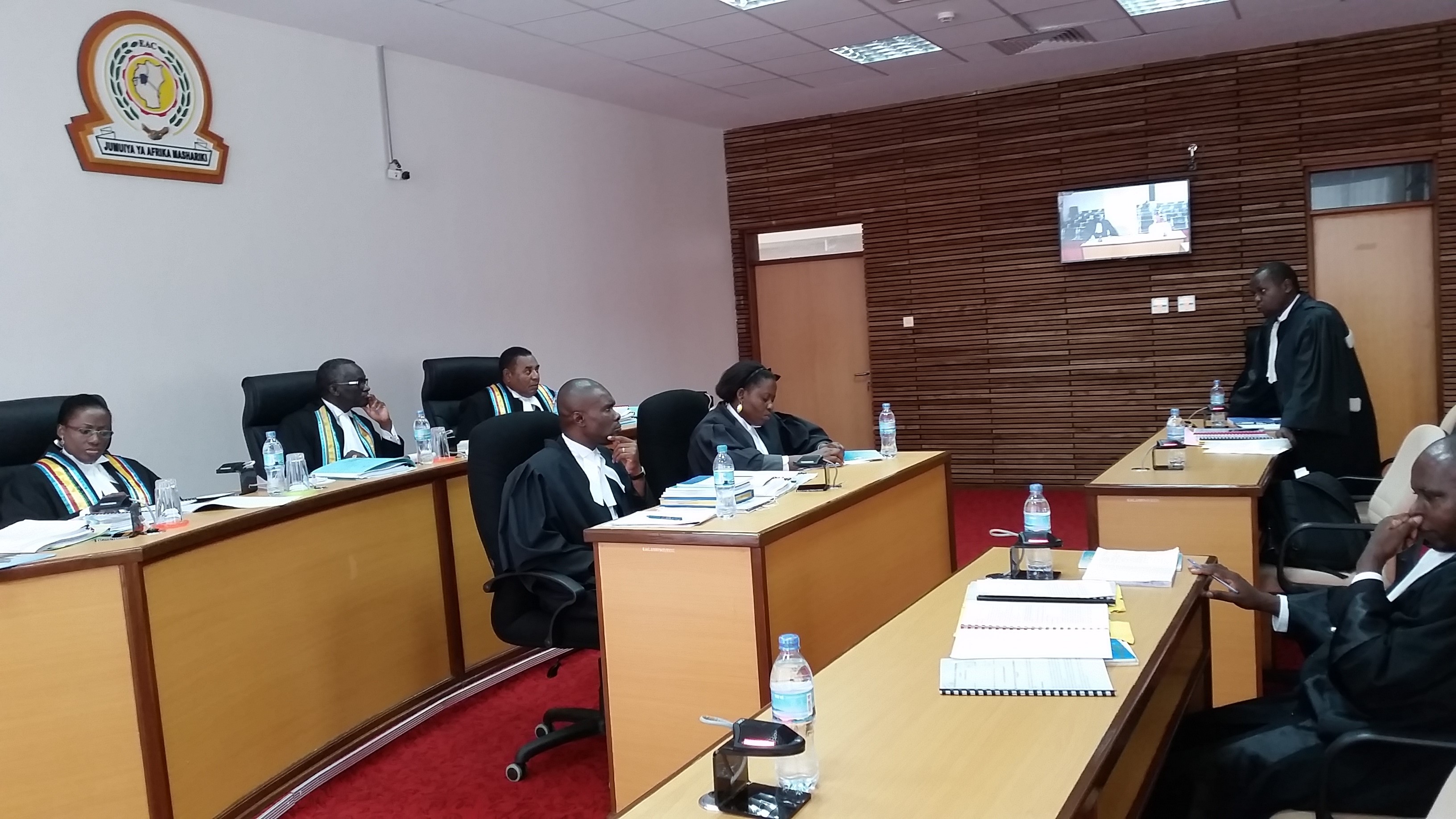
Mr. Horace Ncutiyumuheto Counsel representing the Applicant. Mr. Goerges Ruhara submitting before Court.
East African Court of Justice Arusha, 29 April 2015: The First Instance Division heard a case filed by a citizen from the Republic of Burundi, Mr. Georges Ruhara seeking a declaration of the Court that the force occupation of the house and outbuildings of the Applicant by the Government is an infringement of Articles 6(d) and 7(2) of the Treaty.
Mr. Horace Ncutiyumuheto Counsel representing the Applicant, submitted that in July 2003 during an attack the Applicant was forced to leave his house and since that time his house and buildings were occupied by the Military. He added that Mr. Ruhara was denied the right to access his house and other buildings. That he wrote many letters to the Minister of Defence to get back his house latest was in May 2014 but the Minister of Defence still refused.
Mr. Ncutiyumuheto further urged that the Constitution of Burundi under Article 36 provides the right to citizens to enjoy the right of their properties; however the Applicant has been denied the right. Also that the Applicant’s house is occupied by the Military yet he has not received any rent which is like a force situation of his house which violates principles of good governance and rule of law of the Community.
Counsel also submitted that the Treaty for the Establishment of the East African Community provides jurisdiction to the Court to interpret and apply the Treaty and therefore asked Court to find that the Respondent forcing the Applicant not to enjoy his rights is a breach of Articles 6 (d) and 7 (2) of the EAC Treaty and be ordered to return the properties of the Applicant as well as pay to Georges Ruhara a total sum of 930,581.00BIF
Mr. Nestror Kayobera Counsel for the Respondent (Attorney General of the Republic of Burundi) submitted that, as provided under Article 30 (2) of the Treaty that “The proceedings provided for in this Article shall be instituted within two months of the enactment, publication, directive, decision or action complained of, or in the absence thereof, of the day in which it came to the knowledge of the complainant, as the case may be;”. He urged that this case was filed out of time since it came to the knowledge of the Applicant in July 2003 and was filed to EACJ in May 2014 which exceeds a time limit of two months of the Treaty any matter to be filed to Court.
Mr. Kayobera also added that the Court does not have jurisdiction to grant this amount requested by the Applicant as rental because there was no relationship between the Ministry of Defence and the Applicant. He told Court that there is no violation of the Treaty and asked the matter to be dismissed with costs.
The Court will deliver the judgement on notice
About the EACJ
The East African Court of Justice (EACJ or ‘the Court’), is one of the organs of the East African Community established under Article 9 of the Treaty for the Establishment of the East African Community. Established in November 2001, the Court’s major responsibility is to ensure the adherence to law in the interpretation and application of and compliance with the EAC Treaty.
Arusha is the temporary seat of the Court until the Summit determines its permanent seat. The EACJ sub-registries are available in the Partner States at the premises of the respective National Courts.
For more information please contact:
Ms. Geraldine Umugwaneza, Acting Deputy Registrar
Email: umugwaneza@eachq.org
Owora Richard Othieno, Head of Department;
Corporate Communications and Public Affairs Department;
EAC Secretariat
Tel: +255 784 835021; Email: othieno@eachq.org
East African Court of Justice
Arusha, Tanzania
https://www.eacj.org/